
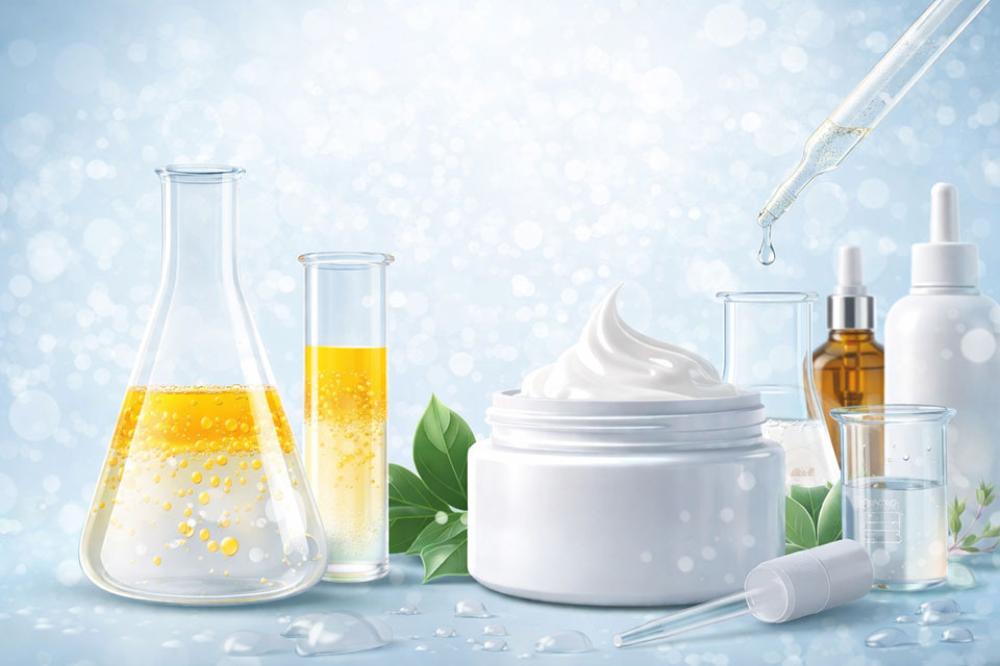
What are cosmetic emulsifiers? And why are they essential in the manufacture of creams?
If you are starting to manufacture skincare products or developing your own product line in Saudi Arabia, one of the first concepts to understand is emulsification .
Oil and water don't mix by nature. Yet, creams and lotions on the market have a smooth texture and last for months. The secret lies in the use of emulsifiers —essential raw materials in the cosmetics industry.
An emulsion is a substance that contains two parts:
- Hydrophilic part
- Oil-loving (lipophilic) part
Thus, it acts as a link between the two phases and prevents separation.
How does the emulsification system within the cream work?
When the oil phase and the water phase are heated (usually between 70–75°C) and then combined with thorough mixing, the emulsion coats the oil droplets and fixes them inside the water, or vice versa.
The finer the distribution of the droplets, the finer the consistency:
- Bless
- More stable
- Less prone to separation
For this reason, it is advisable to use a homogenizer in semi-industrial production.
Types of emulsifiers in cosmetics
1️⃣ Oil-in-water emulsion (O/W)
In this type, the oil is distributed within the water.
The result: A light, fast-absorbing cream.
It is used in:
- Skin moisturizers
- lotion
- Day creams
- skin lightening creams
Common materials used in this system and available in raw materials stores include:
- Glyceryl Monostearate (GMS)
- PEG-40 Hydrogenated Castor Oil
- Polysorbate 20
- Eumulgin B2
📌 You can insert an internal link here to the GMS product page in your store.
2️⃣ Water-in-oil emulsion (W/O)
In this system, the water is surrounded by oil.
The result: a heavier, more nourishing cream.
Used in:
- Creams for very dry skin
- ointments
- winter protection products
The difference between an emulsifier and a solubilizer
Many beginners confuse the two terms.
Emulsifier:
- Used in creams
- It tolerates high oil content (10–30%)
Solubilizer:
- It is used to combine small amounts of essential oils.
- Suitable for sprays (Body Mist – Room Spray)
Practical example:
If you want to incorporate tea tree oil into an aqueous toner, you can use Polysorbate 20 at an approximate ratio of 1:1 or 1:2 depending on the concentration.
The most popular emulsifiers suitable for beginners in Saudi Arabia
🔹 Glyceryl Monostearate (GMS)
A classic emulsion that is easy to use.
It gives a firm, creamy texture.
It is usually used at a rate of 3–5%.
Suitable for homemade cream makers and startups.
🔹 PEG-40 Hydrogenated Castor Oil
Suitable for aquatic products such as:
- body spray
- light serum
- air fresheners
🔹 Cetearyl Alcohol
It acts as an emulsifying aid and adds:
- thickness
- stability
- velvety texture
How do you choose the right emulsifier for your project?
Before choosing the material, determine:
- Percentage of oil in the formula
- Product type (lotion – cream – spray)
- Required product consistency
- Target group (oily skin - dry - sensitive skin)
- Thermal stability requirements (important in Saudi Arabia's climate)
In hot weather, it is preferable to strengthen the emulsification system with aids such as:
- Cetearyl Alcohol
- Stearic Acid
- Xanthan Gum
Example of a moisturizing cream formula for beginners
- 70% distilled water
- Vegetable oils 15%
- GMS at 4%
- Cetearyl Alcohol 2%
- Glycerol 3%
- Suitable preservative 0.8–1%
- Active ingredients as desired
This is an educational example, and reliability tests should always be carried out.
Common mistakes in cream manufacturing
❌ Not heating the two phases to the same temperature
❌ Using a lower percentage of emulsifier than required
❌ Ignore the thermal stability test
❌ Adding sensitive materials before cooling
The importance of stability testing in the Saudi market
Due to the high temperatures in Saudi Arabia, the product may be exposed to temperatures exceeding 45°C during transport or storage.
Therefore, it is recommended to:
- Product testing at 40–45°C for two weeks
- Freeze-Thaw test
- pH measurement after 48 hours
Where can you find high-quality emulsifiers in Saudi Arabia?
Choosing a reliable supplier of raw materials saves you a lot of risk.
When purchasing emulsifiers, make sure of:
- Having a Certificate of Analysis (COA)
- Clarification of purity percentage
- Specifications conform
- Adherence to international standards
At purechem.shop we offer a selection of emulsifiers and emulsifying aids, suitable for beginners and professionals, with clear data to help you develop stable and safe formulations.
a summary
Your understanding of emulsifiers is not just theoretical information, but the foundation for the success of your cosmetics manufacturing project.
Every stable cream on the market started with a correct understanding of the emulsification process.
Start with a simple formula, test thoroughly, and develop your skills step by step.